 HISTORIAPHIL
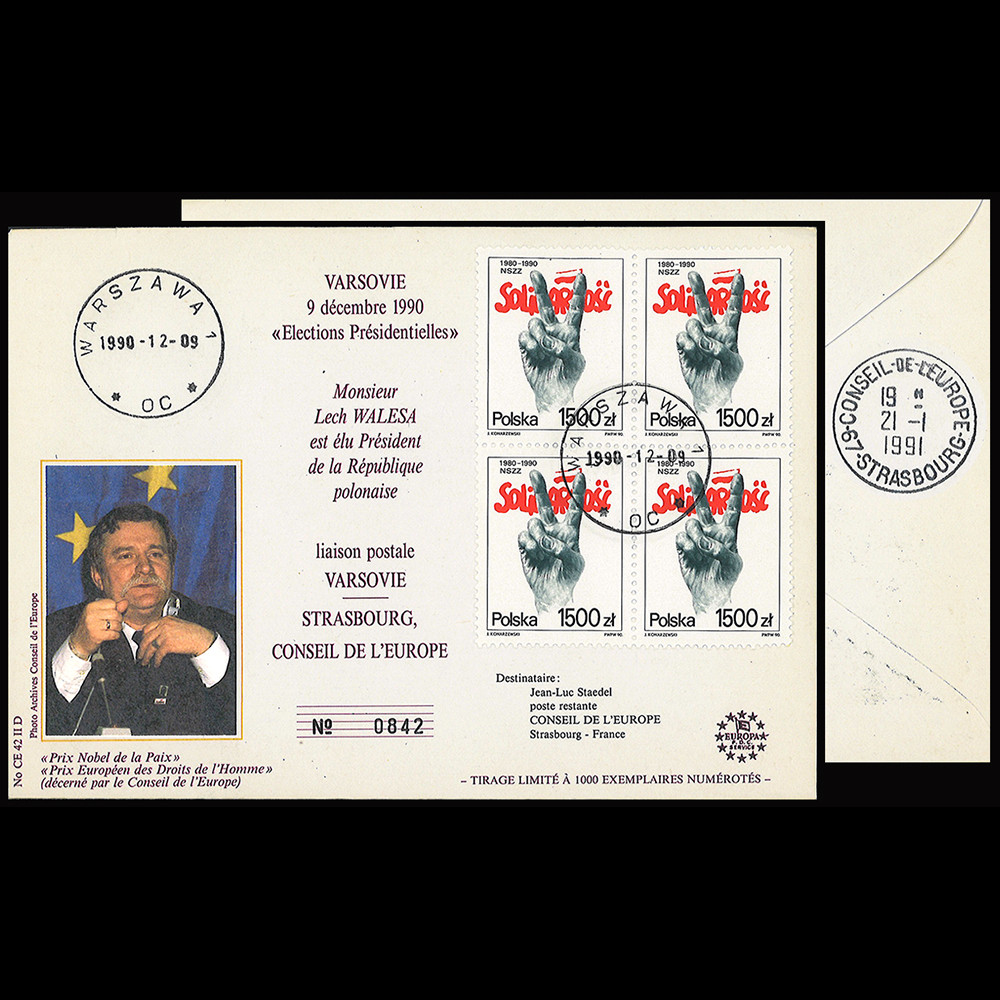
- Postage Poland Block of four 1500 zt “Solidarność 1980-1990"
- Cancellation Warszawa (Warsaw) 09.12.1990
- Sent by postal link Warsaw (Poland) - Strasbourg, Council of Europe (France) with arrival stamp on the back
Collector's Edition - Edition of 1,000 numbered envelopes (FDC) - Rare
Born on 29 September 1943 in Popowo (Poland). An electrician by training, he worked at the Gdansk shipyards where he became a trade union activist. Monitored by the communist regime then in power, he was arrested several times.
In 1980, he played a key role in the negotiations that led to the conclusion of the Gdansk Agreement between the strikers and the government. He then participated in the creation of the trade union federation Solidarność ("Solidarity"), whose membership at one time reached ten million.
Having become an emblematic figure of Poland freeing itself from the influence of the USSR, he was awarded the Nobel Peace Prize in 1983 and the European Prize for Human Rights awarded by the Council of Europe in 1989. The reality of his role as an opponent, however, subsequently became the subject of controversy.
In 1989, the Round Table Agreement led to semi-free elections and a government led by Solidarity. On 9 December 1990, Lech Wałęsa won the second round of the presidential election with 74.3% of the vote against businessman Stanislaw Tyminski. He thus became the first democratically elected Polish president since 1926 and the first to be elected by universal suffrage.
During his five-year term, he led Poland's rapid transition from a collectivist to a market economy. Internationally, he negotiated his country's accession to NATO and the European Union, which would come after his presidency.
Divisions within his camp weakened him, as did doubts about his competence and his character, which was considered crude. Running for a second term in 1995, he was defeated in the second round by the social democrat Aleksander Kwasniewski, receiving 48.3% of the votes cast.
As a candidate in the 2000 presidential election, he obtained only 1% of the vote. He then opposed the governments of the Law and Justice party. Although his image has tarnished in Poland, he still benefits from an international aura. He has received many foreign awards and the Gdansk airport bears his name.
(Source: Wikipedia)
A philatelic envelope, designed by Historiaphil© (Philately Kiosk of the European Parliament, Strasbourg, France) commemorates the election of Lech Walesa to the Presidency of the Republic of Poland, on 9 December 1990. It was produced in the continuity of the collection of philatelic envelopes testifying since 1949, to the history of Europe and its institutions. Its edition is limited to 1000 numbered copies.
Data sheet
Specific References
In the same category: